You can't improve what you don't measure
03/08/2026
I had a NanoVNA-H4 lying around here for a while, and I finally put it to proper use. It's a fantastic little instrument, especially for HF work. With it you can measure SWR, sweep filters, check antenna resonance, and generally get a much better picture of what's actually happening on a line than you'd get with a simple SWR meter alone.
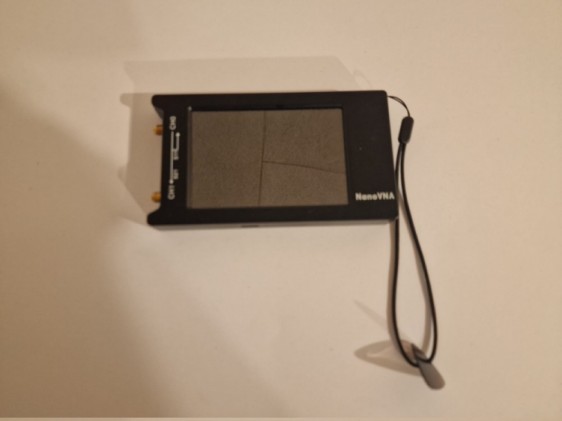
There's one thing about it that bothers me though: the SMA connectors on the unit have no locking nut. They're just the bare male SMA on the board edge. That's fine for quick lab work on the bench, but the moment you connect anything heavier — thick coax going to an antenna, for example, with a regular adapter screwed straight onto the device — those connectors don't last. The mechanical stress on that little PCB-mounted SMA adds up fast, and I didn't want to be the one explaining to myself why the connector snapped off mid-measurement up on the roof.
Pigtails as a compromise
The solution I landed on is pigtails: short lengths of H155 cable terminated in SMA on one end and whatever connector I actually need on the other. H155 is a nice compromise for this — flexible enough to handle without kinking, but with reasonable loss and shielding for HF work. This way all the mechanical strain of connecting and disconnecting goes onto the pigtail and its connector, not onto the NanoVNA itself. If a connector wears out, I just remake that end of the pigtail instead of worrying about the instrument.
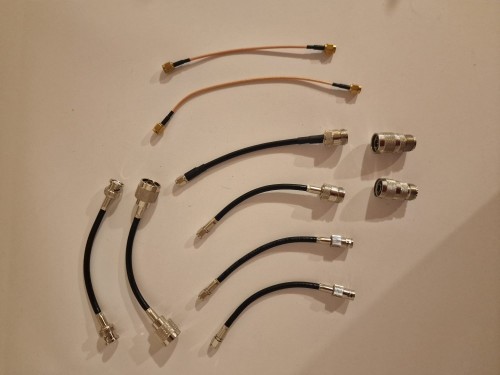
Connector choices in the field
In my antenna installations I try to standardize on N connectors wherever I can. I trust them more than PL-259/SO-239 — they're weatherproof by design, have a much more consistent impedance, and don't suffer from the loose fit that PL-259 is known for. For anything that still uses PL-259 (a lot of older gear and coax does), I only bought adapters rather than building dedicated pigtails — no point duplicating cable runs for a connector type I'm trying to phase out anyway.
Since the NanoVNA already comes with SMA on the unit, I also made a set of pigtails to BNC, since that connector shows up constantly in QRP gear. Between N, PL-259 adapters, and BNC pigtails, I can measure pretty much anything that comes across the bench.
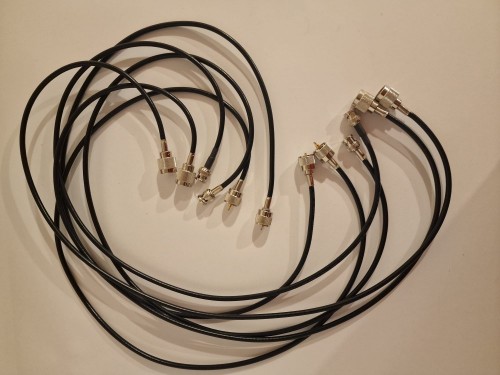
On top of that, I made a set of general-purpose H155 test cables for use across all my systems — the kind of thing you reach for constantly and never seem to have enough of.
A test jig for components
Alongside the cables, I built a small jig with banana jack connectors that I use as a component tester for S11 and S22 measurements. It comes with a couple of leads terminated in crocodile clips, which makes it easy to clip onto a component under test without needing a proper fixture every time.
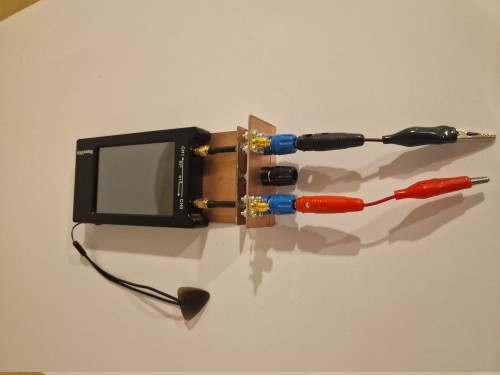
Even on this jig, I still used SMA connectors on the VNA side rather than going straight to banana. Keeping that interface consistent matters for calibration — the calibration standards I use are all SMA, so keeping that connector in the chain all the way to the jig means the calibration stays accurate right up to the point where the crocodile clips grab the component.
A homemade N connector cal kit
Since I'm standardizing on N connectors for antenna work, I also wanted a proper calibration kit in N rather than always adapting down to SMA. I already had a load lying around, so that part was easy. The open and short I built myself, using N connectors and some PCB material for the reflecting plane. It's not lab-grade precision, but for the kind of field measurements I do it holds up well, and it means I can calibrate directly in N without an adapter's tolerance creeping into the measurement.
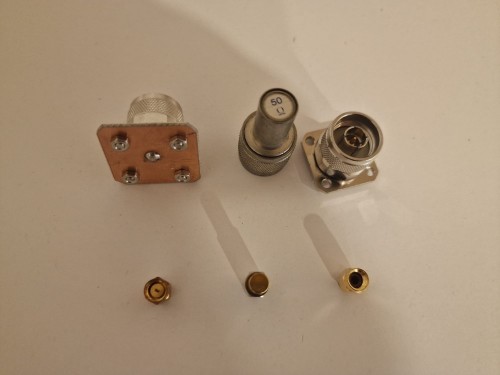
It's a small detail, but in RF work the connectors and cables between your instrument and your device under test are often where accuracy quietly gets lost. A cheap adapter or a worn connector can throw off a measurement just as easily as a badly designed matching network — so it's worth the effort to get that part right.
Comments