Learning CW
01/08/2026
For years I've been following the amateur radio world from a bit of a distance. More recently I've gotten into building a few self-build transceivers sold as kits, QRP Labs being a good example. They're always QRP kits (5W out), and their performance really shines on CW. So sooner or later, if you go down that road, you end up needing to learn Morse code.
Long Island CW Club
A few years back I became a member of the Long Island CW Club, my membership number is 4574. It's a club that runs online lessons over Zoom, alongside talks on all sorts of technical topics. Great atmosphere, genuinely fun. Through their program I learned all the letters, numbers, and a handful of punctuation marks at 15 WPM.
Then, as these things go, my ambitions cooled and learning Morse went quiet for a while.
Enter the Morserino
Some time later I came across the Morserino — a CW training device with built-in paddles, based on an ESP32 with capacitive touch paddles. I used it to learn how to send with a paddle. And, predictably, that effort also fizzled out after a while.
The Morserino Pocket
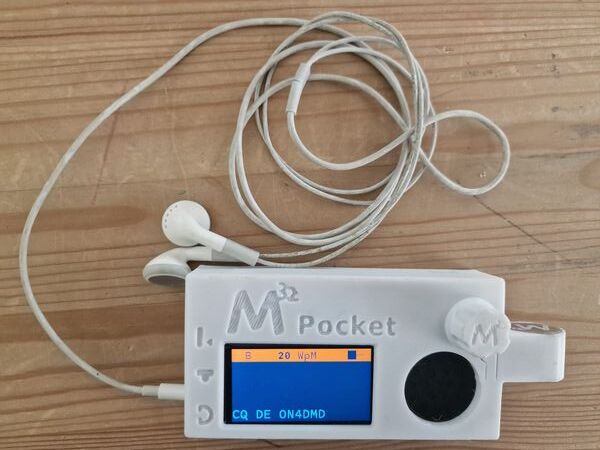
A few months ago I saw in the newsgroup that a new version of this excellent trainer had been released: the Pocket edition. Everything fits into a 3D-printed enclosure, small enough to take anywhere. I ordered one, mainly because I spend some time on the train every day and figured I could use that time to practice.
And that's exactly what happened. The nice thing about Morse is that you don't really forget it, after about a year of not touching it, I could pick up right where I'd left off.
Where I'm at now
These days I mostly use the Echo Trainer: three characters are sent, and you send them back. I run it at 20 WPM, though I still write everything down (no head copy yet).
I also practice copying CW daily on lcwo.net, currently at 25/15 WPM. That means the characters themselves are sent at 25 WPM, but with extra spacing between them so the overall effective speed works out to 15 WPM. This Farnsworth-style spacing helps a lot with learning to recognize the sound of a character as a whole, rather than mentally counting dots and dashes.
On top of that, I listen on the bands regularly and try to follow real QSOs, checking what I have heard against the Reverse Beacon Network.
Getting close
I'm slowly getting to the point where a first QSO feels within reach, I think that easy QSOs like POTA hunting should already be doable, but I still want to get my station properly finished first. More on that in upcoming posts!
Comments